Friday, 25 March 2011

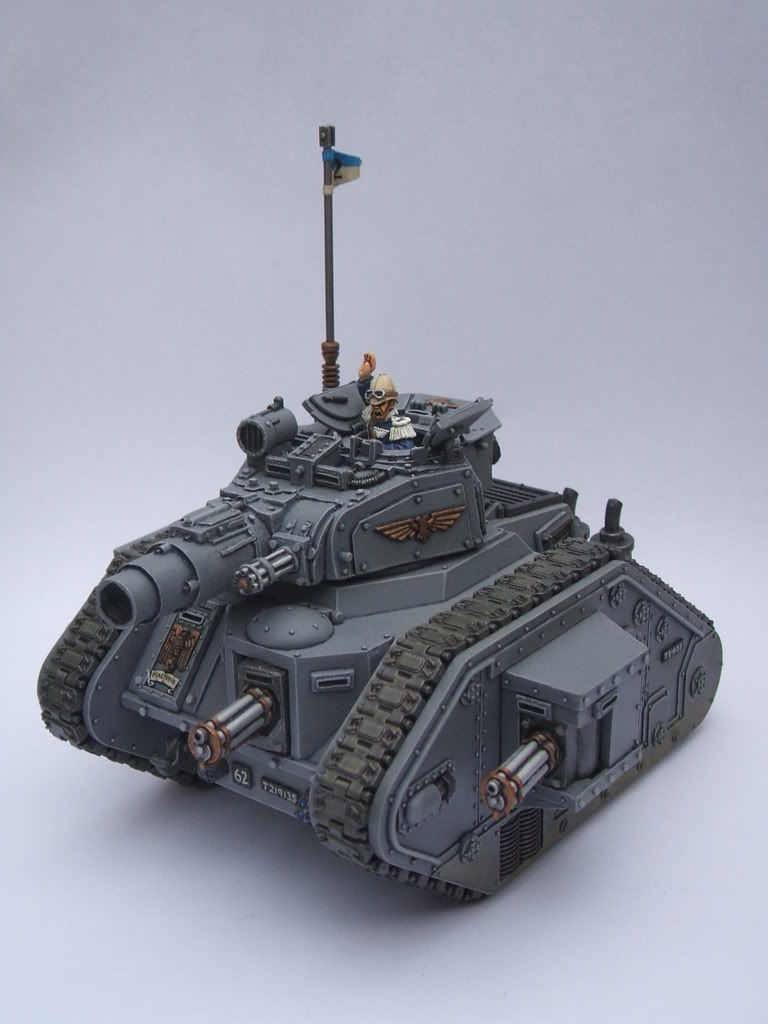
The Praetorian MkI-B Leman Russ Conqueror


Praetoria with its significant industrial capability is one of only a small handful of non-Adeptus Mechanicus worlds producing a version of the Leman Russ Conqueror. How exactly Praetoria came to be in the fortunate position to acquire the designs for this variant of the Leman Russ is unknown. Though given relations with the Adeptus Mechanicus which have until recently been unusually amiable, it is likely they were acquired through legitimate means. This could perhaps be the result of trade, a definite possibility given Praetoria’s wealth and position as a major trading power in the Segmentum, alternatively the designs may have been granted as a reward for some service to the Adeptus Mechanicus.

Irrespective of this, Praetoria’s manufactorums now produce a version of the Conqueror almost identical to the early Mk3 Gryphonne IV pattern in respects of armour and performance. It also originally made use of Heavy Bolters imported from the Adeptus Mechanicus, and was known as the MkI. However, around 450.M41 the design was altered, and these Heavy Bolters were instead replaced by MkIV-I Gatling Guns (cross ref file; 8236B/PRAET102318-VI) in the hull and sponson hard points, resulting in the MkI-B. This is undoubtedly a contributory factor in the souring of relations between the Adeptus Mechanicus and Praetoria, and has been cited in allegations of Techno-Heresy.

The MkI-B has to date been supplied exclusively to Praetorian PDF and Imperial Guard units, with many regiments now fully equipped with the vehicle. As with the MkI and all other versions of the Conqueror, it is a particularly mobile vehicle, indeed it is often dubbed as a ‘Cavalry Tank’. Thus, it is the ideal tank for Praetoria’s ‘Armoured Cavalry’ regiments, which favour a highly mobile form of armoured warfare, specialising in highly co-ordinated, set piece, armoured assaults often involving whole regiments.


PDF DOWNLOAD

Monday, 21 March 2011

The Praetorian MkVIII-H Lascannon and MkII-L Autocannon


INFANTRY SUPPORT WEAPON – MKVII-H PRAETORIAN LASCANNON

Praetorian regiments make use of the standard MkVII Lascannon, be it with some minor aesthetical differnces. Standard power cells are also employed. However, rather then fitting it to the convential tripod mounting often fitted with this type of weapon, the manufactorums of Praetoria which produce them instead mount them to a carriage of local design. This carriage is based upon designs which were used by more primitive blackpowder weapons in Praetoria’s pre-Imperial past, though it has been updated with improved construction methods and materials.

The bulk of the carriage frame and its wheels consist either of natural hardwood, or of a synthetic fibrous material with similar properties. Hardwood, though more expensive, is normally favoured for this comparatively high status weapon. In either case, this material is treated with a resin compound to give it increased ballistic and thermo resistance, and to reduce splintering if it is impacted. The result is somewhat heavier then a comparable metal or composite carriage, but due to its nature it is also far easier to effect improvised battlefield repairs. The carriage is further reinforced by Plasteel bracing, as are the wheels. The gun shield meanwhile is reinforced with an Admantium plate, giving the Lascannon itself, and to some extent the operators, increased protection.

Though these weapons are normally man handled once deployed on the battlefield, beasts of burden or small tractor units are normally used for movement of any significant distance due to the significant weight of these weapons.


INFANTRY SUPPORT WEAPON – MKII-L PRAETORIAN AUTOCANNON

The Praetorian MkII-L Autocannon is a design based on the STC MkII Autocannon and carriage and uses standard ammunition. The weapon differs from the STC design only in its use of local materials, wheel design and in the removal of the gunner’s seat from the trail.

Almost the entirety of the carriage and its wheels are constructed from either natural hardwood or from a synthetic fibrous material with similar properties. Synthetic materials are more commonly used in this instance due to the greater cost of the alternative; this also allows the components to be moulded per the STC design. In either case the material is treated with a resin compound to give it increased ballistic and thermo resistance, and to reduce splintering if it is impacted. The significantly enlarged wheels are reinforced with Plasteel fittings, as is the gun shield giving a limited amount of protection for the weapons mechanisms. Its construction makes it somewhat heavier then an alloy or composite weapon similarly constructed to the STC design, but it is easier to affect improvised battlefield repairs as a result.

These weapons do not have a tow fitting as standard. This is because they are normally man handled on the battlefield, being of a weight that an individual Guardsman can comfortably move unassisted over some distance. For travel over longer distances the weapon can easily be dissembled for transport.

PDF DOWNLOAD