In the run up to this years Vanquish, and being very aware of the fact that the Tournament list I've been testing out lately is a long way from being ready to put on the table outside of the local club. Lots of painting still to do. However, thats not a worry as I've been feeling a strong fluffy sensation lately. My list was thus drawn up, and I'm leaving the Valkyrie and maxed out Heavy Support options at home, let alone Vets and Chimeras. Instead no two units are the same, I've brought the Mortars out of retirement, and am using it as an excuse to try out both Mogul Kamir the Roughrider special character (using my Major Ackland conversion via counts as) and to roll out my Lord Commissar with Powerfist (it's terrible, I've had the model painted for ages but have never put it on the table before!).
I'm also spending some time expanding on my Praetorian background articles, there are several in the works, with the Rocket Troughs/Mortars piece just finished.
But I'm going a little bit further then that as well, I always wanted to have a little folder with background to take to tournaments and similar events, a 'presentation' version of the background, so now thats what I'm doing. So I thought I'd share the PDFs if anyone was interested (the Gatling and Rocket Trough ones are done as I post this). There is a download link (hosting on Mediafire, so sorry about the odd pop-up if you do download) on the individual pages of each fluff portion, and on the Background Article menu.

Sunday, 20 March 2011


The Praetorian Rocket Trough
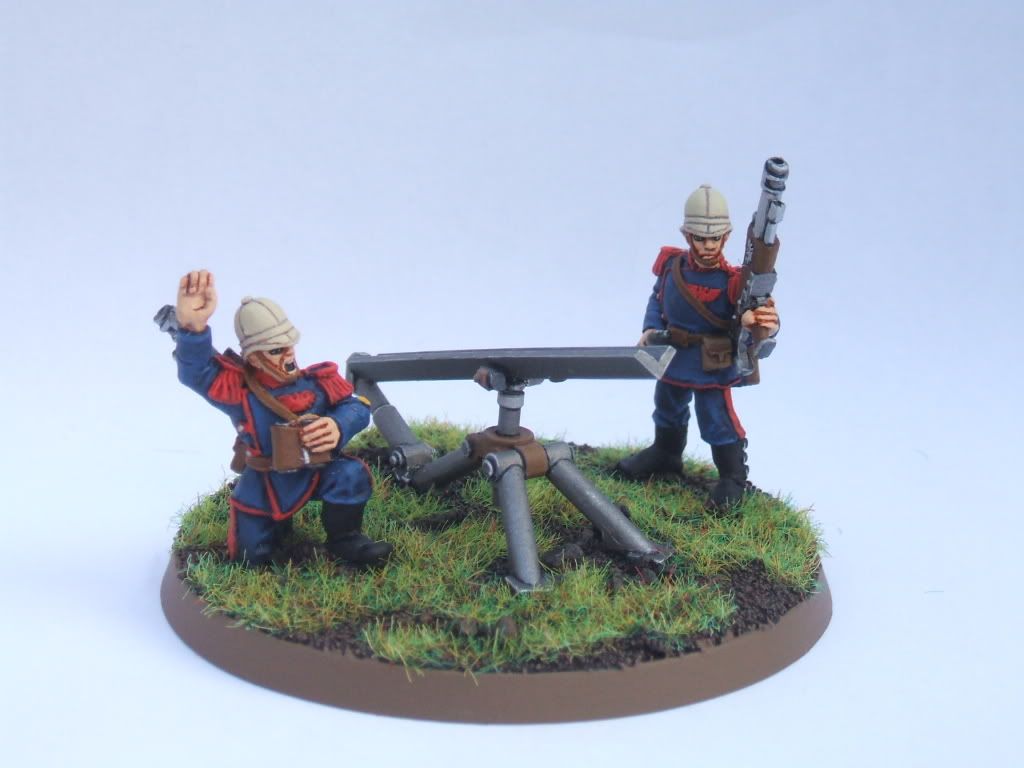
The Rocket Trough is an infantry support weapon which fulfils the same role as the more traditional Mortar. This example originates from, and is chiefly produced by the weapons foundries of Praetoria, though a number of other worlds are known to have developed and produced similar weapons independently. On Praetoria the weapon has its origins in early intra-colonist conflicts.
Throughout its history the Rocket Trough itself has varied immensely in specification, with various sizes, designs and materials used. Some recorded variants have even combined multiple launchers to create a potentially devastating, if unpredictable salvo fire system. Ammunition has varied just as much over its history. The earliest known examples were individually crafted specially for the weapon for which it was intended. In more recent times there has been standardisation with two different sizes of rocket produced, so allowing mass production. One size of rocket is the ‘standard’ man-portable type commonly used by Praetorian forces up to the present day. The other variant was for a larger trailer or vehicle mounted version which has now largely ceased production, its role now filled by more conventional weaponry.
Rocket Trough Design -
The design of this weapon is very simple; its main component is the launching rail, normally a tube or v-shaped section of metal or ceramic proof against rocket exhaust. One end of this launch rail is mounted on a sturdy base with a blast plate; this will sit on a pivot directly fastened to the ground or take the form of a sturdy tripod. The other end of the launch rail is typically mounted on a bi-pod, this mount will also be of adjustable height so as to alter the angle of the launch rail, and thus the trajectory of the rocket when fired. The firing takes place either through the use of electro-igniters, or using a friction based lanyard.
Assuming stability can be achieved the accuracy of this weapon rests entirely in the operators grasp of the behaviour of the projectile in flight, including its weight if a non-standard payload is carried and its propulsion. In the hands of an expert such a weapon is justifiably more accurate then a more tradition Mortar, however if the operator is not expert the weapon is inaccurate at best. The weapons design also gives the potential for the weapon to be fired directly. While this posses an extreme hazard for the operator it does mean the weapon can be employed in a fashion similar to a Missile Launcher in dire circumstances, for example engaging enemy armour, given an appropriate warhead.
Ammunition -
The Rocket ammunition currently produced consists of two main components, a solid fuel engine and a warhead. The engine is vented in such a way as to cause the rocket to spin about its axis in flight, so improving its accuracy. This engine also gives the weapon its greatest benefit over a standard Mortar, as it can be manufactured with a larger engine charge giving it a greater maximum range.
The warhead is normally a Frag charge, used to cause infantry casualties over a small radius. Smoke rounds are reasonably common, and others including Krak basd warheads are produced in small quantities. Should such ammunition run out however, it is also possible to use standard Missile Launcher Missiles. This is very hazardous however; as the Missiles must be modified in order to be fired via this method. It also requires the operator to have a great deal of experience in order to compensate for the different behaviour of the projectile.
Subscribe to:
Posts (Atom)